Any installation for aggressive process conditions starts with the medium, not with the drawing. Temperature, chloride content, contaminants. Only once that picture is complete does the question of material become answerable.
For this project the medium was a heavily contaminated saline waste stream at high temperature and extremely high chloride content. Seven candidates went into it as welded coupons, because the weld and the heat affected zone are almost always the weakest point of a construction: 316L, duplex 2205, superduplex 2507, the 6Mo austenitics 254 SMO and alloy 926, the nickel alloy Alloy 625, and commercially pure titanium Grade 2. Test temperature 95°C, the temperature of the boiling brine in the future installation.
Every stainless steel and nickel coupon came back with pitting and crevice corrosion, including Alloy 625. The titanium coupon was untouched.
The mechanism explains the gap. Stainless steels and nickel alloys protect themselves with a chromium oxide layer, but oxidising components in the brine raise the electrochemical potential and break that layer open locally, first in crevices under salt deposits. Titanium protects itself differently, with a titanium dioxide layer a few nanometres thick that repairs itself as long as there is something to oxidise. The same components that destroy stainless steel keep titanium passive.
Four grades, one brine
Titanium has one weakness in this service. Above roughly 70 to 80°C, unalloyed titanium can still corrode inside crevices, where the local environment runs out of oxidisers. The installation therefore uses four grades, each where its property counts.
Grade 2, commercially pure titanium, does the general plate, pipe and flange work: vapour body, piping, tanks, recirculation pump and the wet parts of the centrifuge. It is corrosion resistant on open surfaces, weldable, formable and widely available.
Grade 7, titanium with 0.15% palladium, sits in the flanged connections in hot brine. A gasket crevice cannot be designed away, and palladium lifts the crevice corrosion limit well above process temperature.
Grade 11 is the same alloy on a softer Grade 1 base. Same corrosion behaviour as Grade 7, soft enough to be pressed into the corrugation of a plate and frame heat exchanger plate.
Grade 12, titanium with 0.3% molybdenum and 0.8% nickel, forms the tubes of the heating bundle. That is the hottest wet surface in the installation and the place where deposits are most likely, so it needs extra crevice resistance at elevated temperature. It is also stronger than Grade 2.
The calculation has changed
Until recently this test result was where the business case stopped. Titanium won the test and lost the budget. The kilo price has dropped from around eighty euro to around thirteen, largely on scaled up production capacity in China, and it is more stable than nickel and molybdenum alloy pricing. For a project budgeted over several years, that predictability counts as much as the price itself. For this client the payback period comes out at roughly one and a half years.
Cheaper, not easier
The material became affordable. The processing did not become simpler.
“Titanium is a beautiful material to work with. But it is far more complex than stainless steel. The reactivity is extreme.” Johan Siemonsma, COO
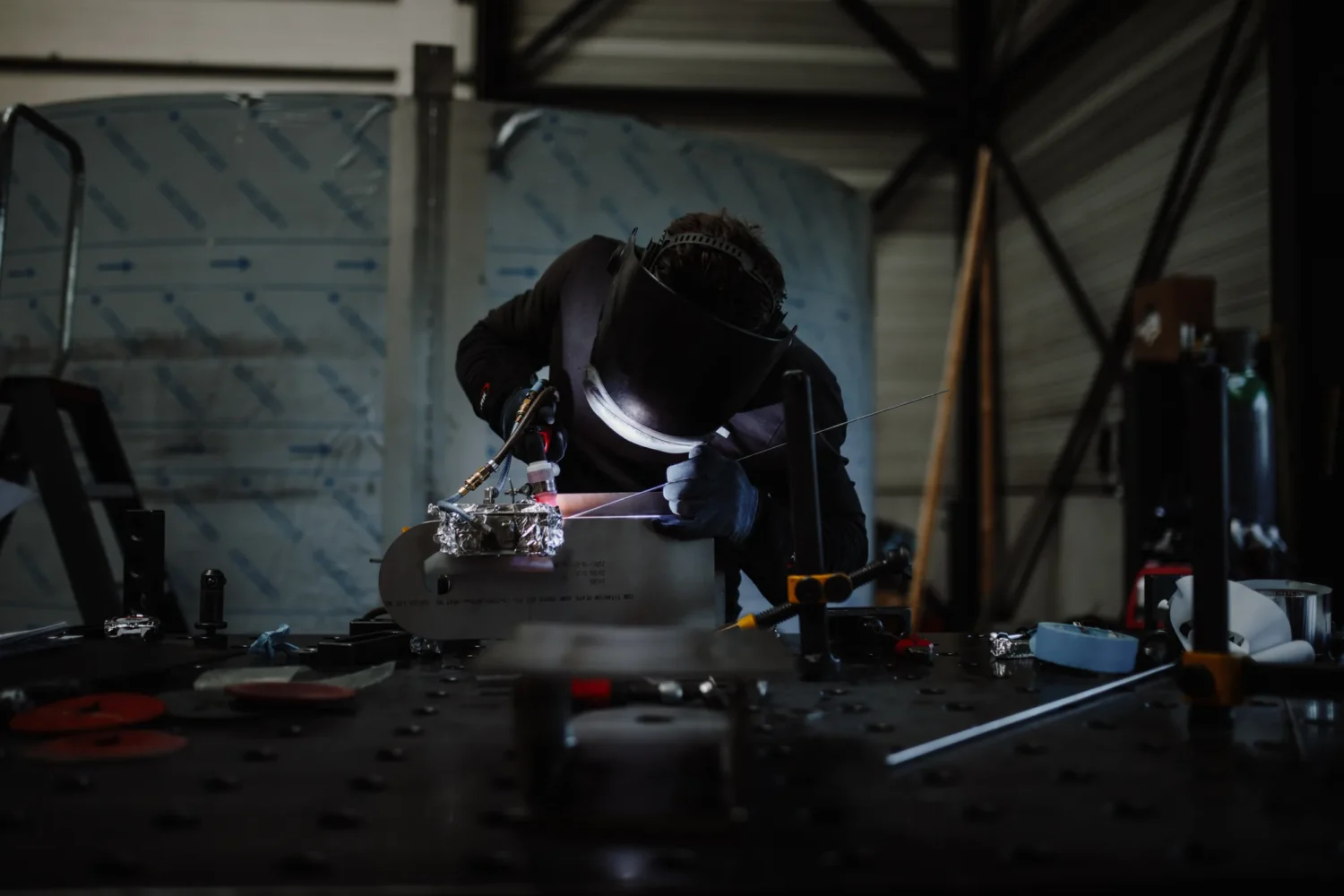
Above roughly 450°C titanium absorbs oxygen and nitrogen, which embrittles the weld. Gas shielding has to be perfect. Special shoes protect the weld until it has cooled sufficiently. Titanium grinds badly, so a plate edge milling machine is needed for weld preparation. The material has to be processed in a contaminant free environment, which is why Titan set up a dedicated hall to work clean at this scale.
Twelve welders work on the project, colleagues who chose to specialise in titanium and who helped select the tooling, including automated wire feed for the TIG process. The investment in people, equipment and training runs well over one hundred and fifty thousand euro. That is the real threshold: the equipment, the training and the organisation around it are not built up for a single project.
What is being built
The line concentrates the contaminated brine under reduced pressure into vapour and salt crystals, with mechanical vapour recompression reusing the energy in that vapour, and finishes the salt in a split body dryer. Close to forty tonnes of titanium, with a crystallizer that measures thirteen metres on completion.
Titan Salt carries the full route: corrosion testing and material selection, engineering, fabrication, transport, assembly and commissioning. The installation travels in sections by truck to Rotterdam and by ship to the United States, where Titan Salt supervises assembly and start-up on site.
“That is a lot more than welding and shipping. Turnkey means we are responsible until the installation runs.” Robert van Voorst, CEO